
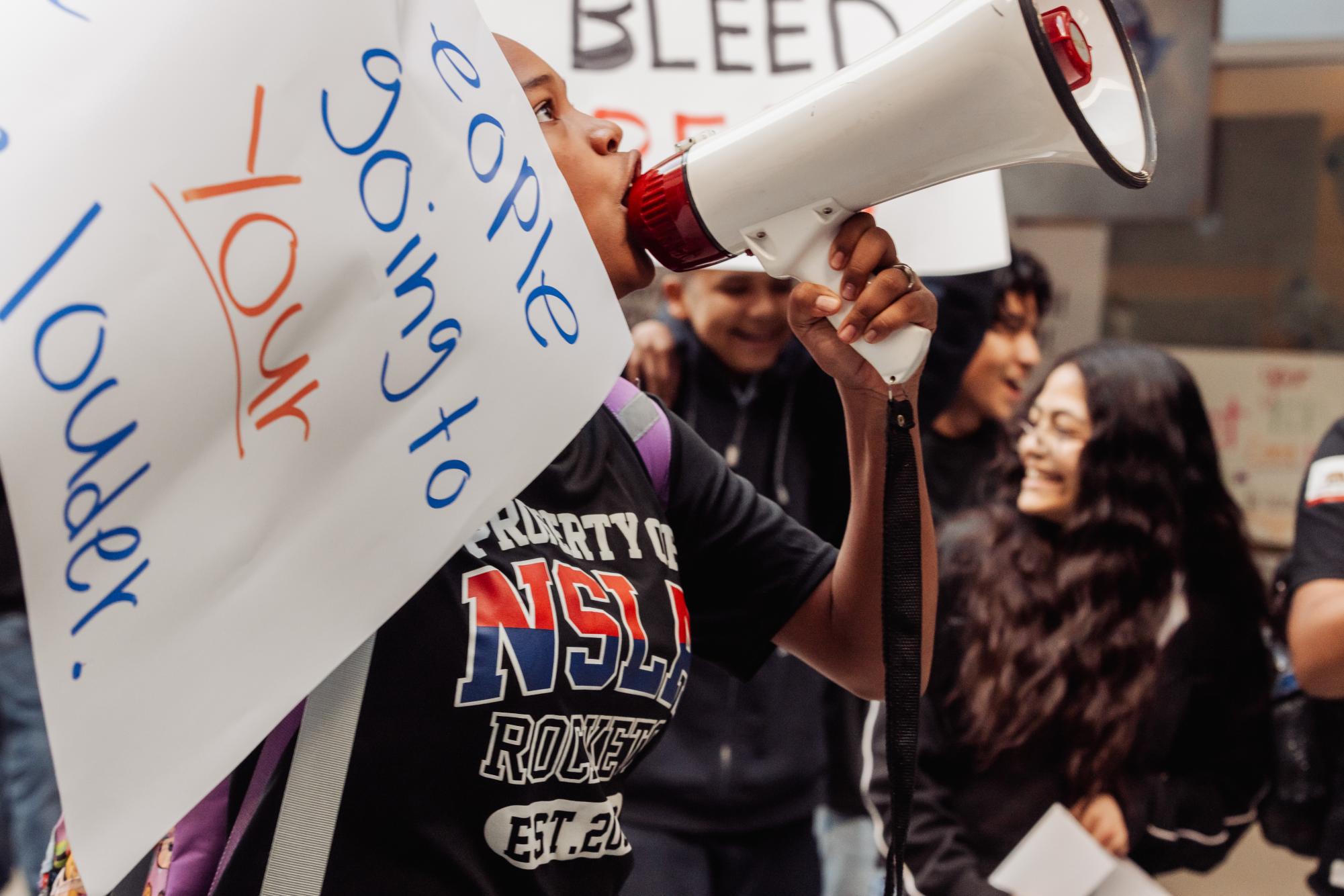
After school on Friday, Feb. 6 Norton middle and high school students marched out of their classes in the E-building holding signs–marking the second time since Jan. 30, 2026 that Norton students engaged in an after school protest and the first times that students engaged in on-campus protest. Students took to the outdoor stage and surrounding quad area, chanting and raising pickets with scrawled messages like “We need ice in our drinks NOT our streets” and “Silencing people isn’t going to make your voice louder” to highlight frustration at Immigration and Customs Enforcement (I.C.E.) operations and some political leaders’ criticisms against the increase in student protests. School Resource Officers (SROs), Campus Security Officers (CSOs), and school principals supervised the student protest to monitor safety but did not participate. Students continued demonstrating for about thirty minutes until students needed to exit campus for after school pickup.
Norton student activism follows the nationwide increase in student-led protests following the deaths of Renee Nicole Good and Alex Pretti by I.C.E. in Minneapolis. That recent rise in student activism spiked on Jan. 30, 2026 with a “National Shutdown” inspired by the preceding one-day shutdown in Minnesota. Hundreds of students across the Inland Empire–including in cities like Riverside, San Bernardino, Ontario, and Fontana, among others–participated in that initial wave of student activism on Jan. 30, and many students nationwide have continued to participate in protests, marches, and walkouts since that date. Youth activism has also risen over the past ten years. According to research by Tufts’ Center for Information and Research on Civic Learning and Engagement (CIRCLE), more young people have reported participation in marches and protests since a decade ago; from 5% in 2016, to 18% in 2018, to 27% in 2020.

“I wanted to participate in the protests because I wanted to honor where I come from,” junior Xitlaly Soto (‘27) said. “It is important to understand that we have opportunities because of what our family sacrificed before us.”
But Norton students, including ones that participated in protests, expressed that they were not sure or confident what rights they actually had as student protesters, or that they feared there would be punishment from school administration if they did participate.
“I believe that not many students acknowledge their First Amendment rights because they fear what might happen to them from the school administration,” junior Fernanda Hernandez (‘27) said. “So students do not end up participating in stuff like protests, even if they agree with what is being said.”
However, student activism is, in many ways, protected in California, a “New Voices” state. “New Voices” refers both to a grassroots movement and series of laws that protect students’ First Amendment rights in certain states across the country, inspired by the principles of the 1969 Supreme Court ruling in Tinker v. Des Moines. Students and student journalists not in “New Voices” states can be subject to significant censorship and retaliation from their school administration due to the impact of the 1988 Supreme Court case Hazelwood v. Kuhlmeier.
Specifically, California Education Code 48907 permits students in public schools, including charter schools like Norton, the legal right to free expression, including distributing materials (e.g., pamphlets, posters, etc.), wearing insignia (e.g., buttons, sashes, etc.), and sharing views (e.g., political opinions, criticism of school policies, etc.), so long as the expression is not obscene, libelous, slanderous, or causes a substantial disruption to school operations. Additionally, student journalists have the right to document student protest and other free expression–whether in photo, video, audio, or writing–without fear of punishment or censorship by school officials.
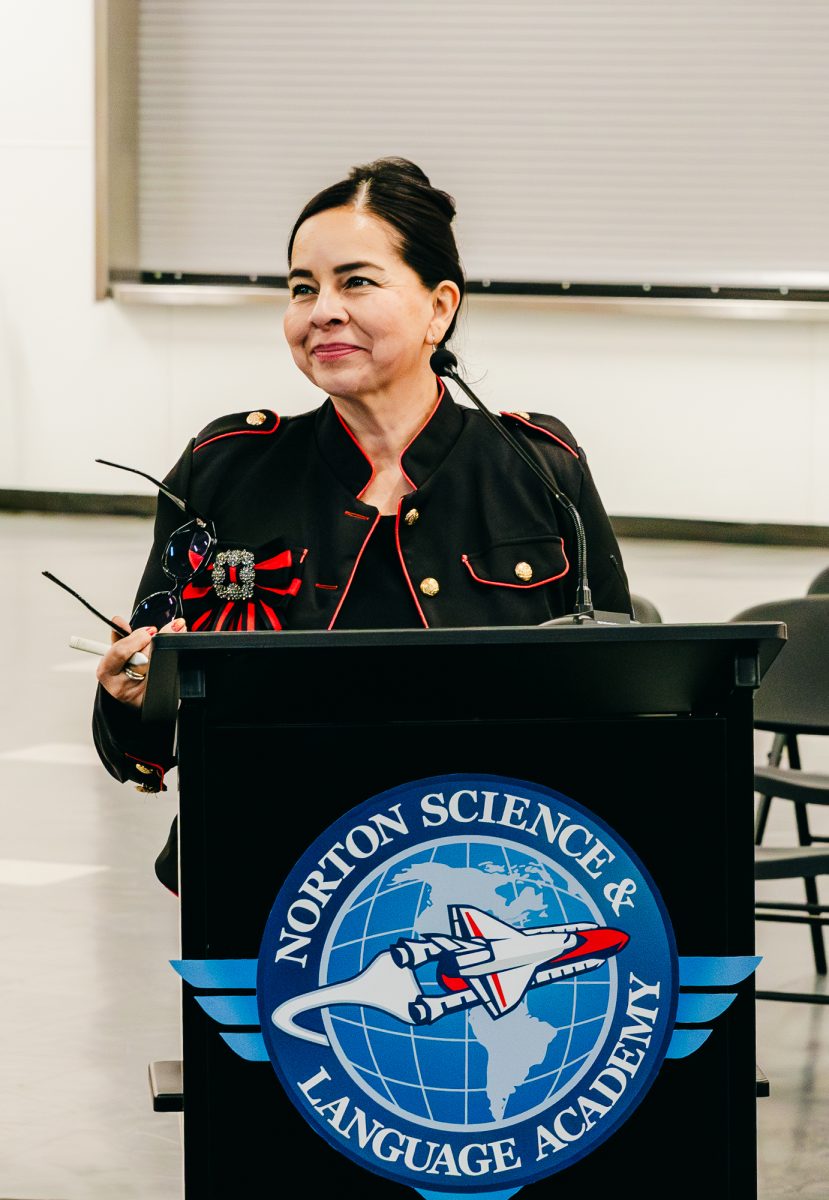
Norton Principal Erika Agosto shared her thoughts about acting as a school official expected to uphold the education code.
“We support your ability as students to wrestle with thoughts that are going to form who you are in the future, and part of that is being able to speak your minds and ask questions without fear of blowback,” Agosto said. “That’s our job–to make sure that we are there as a sounding board so that you can wrestle with those thoughts and come to your own conclusions. I also want to say that students walking out at the end of the day or communicating with administration before an event like a protest is important to keep track of students and make sure that everyone is safe. As a school, too, we must remain officially neutral.”
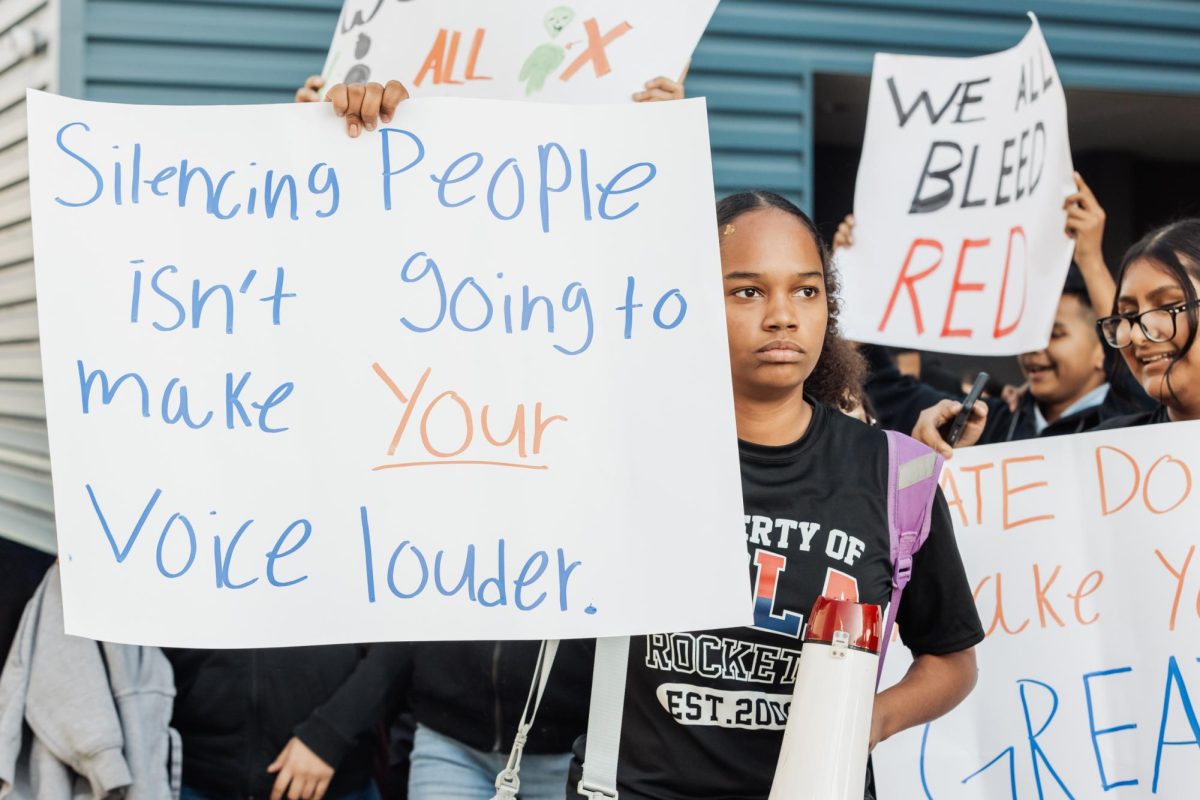
Norton students noted that, in their opinion, protests raised awareness on important issues and showed other students that they have the right to free expression.
“There’s a lot of stuff going on right now that people aren’t speaking up about, but they are issues that young people are going to have to live with for the rest of their lives,” eighth grader Mia Youngblood said. “Students usually don’t know what’s going on in the world. They’re ignorant and they don’t even know that they’re ignorant. But they’re going to have to deal with it when they become adults and realize that those issues do affect them.”
“I think students see that they can raise awareness at school without having to go out in the streets or risking getting hurt,” eighth grader Avery Bui said. “I think students should bring up ideas to administration and plan it beforehand so everything goes smoothly. I think everyone should take a chance of speaking up, regardless if you have immigrant parents or immigrants in your family. It’s all about making a change in our society.”
“The protests help students understand their First Amendment rights by letting them see that they do have the ability to express their opinion without fear from the school,” Hernandez (‘27) concluded. “And that you can speak up for those who might be too afraid or too vulnerable.”