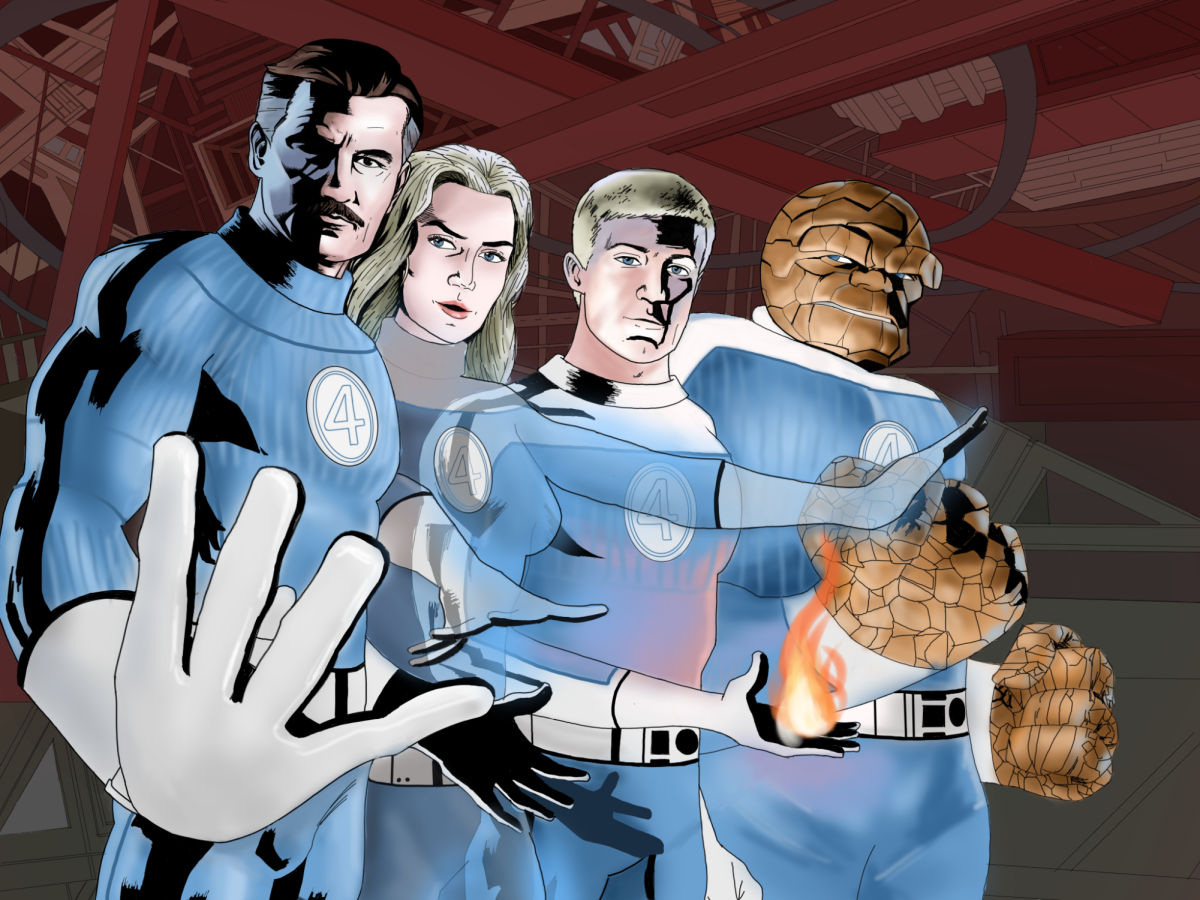
Editor’s Note: “The Fantastic Four: First Steps” is a PG-13-rated superhero movie. Common Sense Media approximates that “First Steps” is suitable for audiences 11 and older. The movie contains some strong language, some depictions of alcohol consumption, and frequent comic-book-style violence that endangers a mother and child. This review only references the looming threat of the main villain and some intense action sequences.
Save the world or save one’s own child? Protect the present or risk everything for the future? Those are the stakes and moral dilemmas at heart in one of the latest films of the Marvel franchise, “The Fantastic Four: First Steps.” Director Matt Shakman suggests that the only way to save the planet is to fight for the lives of those we love, not surrender or sacrifice for an “easy” win achieved through convenience. It may not seem like the world needs another Marvel movie, but “First Steps” cuts to the heart of what superheroes are supposed to do–fight for the future of all, not the few–even when it is difficult.
“The villain in the movie, Galactus, is a giant, planet-eating monster–but, in ‘First Steps’ instead of going after a whole planet, Galactus goes after the baby of Reed Richards and Sue Storm,” high school English teacher and avid Marvel fan David Tellyer said. “That conflict is really interesting–it makes you think about what we sacrifice for our consumption now. We want objects and stuff as quickly as possible in large amounts. Making all that stuff affects living conditions for children around the world now as well as future generations of young people who have to deal with the environmental waste. Galactus is sort of like human vice and greed.”
As Tellyer describes, “First Steps” shows how the most moral and rewarding decisions require more work and sacrifice than the simplest solution. The film effectively develops that theme by showing The Fantastic Four’s commitment to pursuing difficult-yet-fruitful fixes to personal and world problems. During the film’s opening, a recap shows The Fantastic Four gaining their powers via a cosmic storm that genetically alters their DNA, then promptly using their newfound global influence to start organizations like the Future Foundation that mandates participating countries to dismantle their armed forces. Reed, the hyper-logical scientist with super-human elasticity, runs countless tests on their future child, Franklin Richards, to ensure Franklin faces no significant medical risks. Additionally, to prepare for Franklin’s birth, Reed spends his time delegating typical parent “nesting” behaviors–like having H.E.R.B.I.E. building Franklin’s crib. Furthermore, doing extraordinary actions–like tracking and stopping 47 criminal organizations. As Ben Grimm (aka The Thing) remarks when he learns what Reed has done to fight crime for Franklin, “You babyproofed the world.”
“First Steps” also adds greater conflict and suspense to its story by showing its superheroes facing public backlash and making unpopular-yet-worthwhile decisions. These types of conflict for superheroes, rather than widespread public praise, have previously led to more complicated Marvel offerings like director Sam Raimi’s “Spider-Man 2” (2004) (e.g., Spider Man criticized in the press) and Jon Favreau’s “Iron Man” (2008) (e.g., Tony Stark stopping the manufacture of weapons). Some of the tensest moments of “First Steps” show the Four’s reckoning with an angry mob, like Sue Storm addressing the crowd in front of Baxter Building, the Fantastic headquarters. Boldly, Sue announces,“I will not sacrifice my child for this world. But I will not sacrifice this world for my child… We will fight this together… As a family.” After Sue’s proclamation, the team coordinates worldwide energy curfews, again highlighting how challenging it is to choose a precarious path toward morality.
Emotionally impactful performances–especially by loving-yet-terrified new parents Reed (played by Pedro Pascal) and Sue (played by Vanesa Kirby)–also profoundly emphasize the importance of moral risks. While superhero movies have a reputation for cliché and cheesiness, “First Steps” elevates typical superhero fare with sincere, emotional depictions of parenthood–a subject not typically seen in Marvel movies’ endless action sequences and superpowered villain-fighting. (After all, how does a superhero have the time to fight crime amidst constant diaper-changing and routine bottle-feeding?) But from the moment Reed learns that Sue is pregnant, a perturbed and panicked version of him emerges, developed through Pascal’s deft portrayal that navigates the line between scientific logic and human fear. For example, in moments of danger–like Galactus targeting Franklin as he destroys New York or chasing the Four’s ship in a near-death escape plan–Pascal shows how Reed locks into cold, rational focus as he battles alarm at the thought of something happening to his team, wife, or child.
Kirby’s performance of Sue refreshingly takes the place of a typical Marvel hero, embodying courage and sacrifice.
“Sue Strom truly is the heart and soul of the whole Fantastic Four team in the movie,” Tellyer added. “She’s able to activate her deepest powers from the newfound love and protective instinct she has from being a mother. Franklin also adds his own powers into the mix out of the love he has for his parents.”
Even the Silver Surfer, a character working for the villainous and godlike Galactus, gets a bit of a backstory and transformation.
“True to comic book accuracy, the Silver Surfer betrays Galactus in the end,” Tellyer explains. “But this is after the audience learns that Silver Surfer is actually Shalla-Bal, a mother from the planet Zenn-la that sacrificed herself to save her family. This really connects back to the worry and conflicts the Fantastic Four team faces with saving Franklin.”
Comic relief is also provided effectively by Ben Grimm (aka The Thing) (played by Ebon Moss-Bachrach) and Johnny Storm (played by Joseph Quinn)–but, uniquely for a superhero movie, this comic relief is shown through a brotherly bond. For instance, Storm teases Ben throughout the movie that it’s “clobbering time,” a line that repeatedly annoys Ben because, as he puts it, “It’s not really something I say… It’s just in the cartoon.” Ben, too, returns the favor by crushing Johnny’s action figure with the dry response, “Flame off.”
But Quinn’s performance of Johnny really stands out when he balances wit and charisma with heart and vulnerability. Quinn shows Johnny’s character not just charming Silver Surfer, for example, but trying to understand her backstory with empathy and open-mindedness. Eventually, Johnny is able to understand her native language so well that he is able to communicate with her in Times Square. Quinn, too, highlights Johnny’s care and dedication to being an uncle. When Sue first announces she is pregnant, Johnny shows immediate excitement and commitment. That commitment is most memorably showcased at the end when Johnny risks his life against Galactus to save Franklin. “Tell Franklin Uncle Johnny loves him,” he says as he flies away to try and sacrifice himself.
Moss-Backrach’s portrayal of Ben was also great–but the character’s potential was underutilized throughout the movie, especially in the first half. Initially, Ben is there only as a contrast to Johnny’s energy and enthusiasm, providing dry humor and brother-like joking. When Ben does get more development in the second half it is mainly through a connection with Rachel Rozman (played by Natasha Lyonee), a Yancy Street elementary school teacher. Although there is an interesting thread implied about Ben’s joy in serving children in the underprivileged community he grew up in, it is sidelined for a more box-checking romantic interest plot.
Many fans expressed a desire to see more of Ben’s backstory and character development from humble beginnings to a member of the Four.
“My favorite character has to be The Thing,” junior Izamal Lopez (‘27) said. “He has so much potential as a character that is seen as a monster but is really just a lovable guy. But they didn’t really show that as much as they could have. They show him returning to his old neighborhood by the school at the end, but we don’t get to see him connect with his past as much.”
The visuals of “First Steps” also believably and impactfully compare and contrast the difficulty of good in the face of staggering evil. Although Marvel is notorious for having inconsistent digital world-building, Shakman’s efforts provide a fresh and immersive experience. Some notable examples of flat and flawed visuals include the inconsistent CGI (computer-generated imagery) in “Black Widow,” the floating face of Axel in “Thor: Love and Thunder,” and Najma’s lackluster death in “Ms. Marvel.”
In comparison, Shakman works to create consistent renderings of Ben and his appearance changes, more detailed representations of super-powers and oncoming threats, and more serious depictions of villains and their destructive capabilities.
Most notably, Galactus’s visual scale and intensity juxtaposed against the helpless people of Earth-828 and the tininess of baby Franklin highlight the film’s moral weight.
“The visuals were impressive, especially when they used their powers against Galactus,” junior Elizabeth Fregoso (‘27) said. “The visuals did not feel cheesy or green-screened. They felt clean and intense.”
“When I saw Galactus enter the screen for the first time, I was just like, ‘Oh my god,’” Tellyer added. “They really emphasize the scale of his villainous character. When Silver Surfer introduces Galactus on his worldship Taa II, she says, ‘You’re in the presence of Galactus.’ The audience is left thinking, ‘Well, where the heck is he?’ And then they show his colossal head, which is the size of the throne room they are in, open his eyes and it is just magnificent. I do wish they showed more of Galactus’s true destructive power, though. I wanted to see more crushing or more leveling of the city to show the sheer power he wields compared to the people of Earth. It was a little underwhelming in that sense–but I guess the counter to that is the audience knows he is capable of destroying the planet.”
Ultimately, though, the legacy of “First Steps” is that of a “no-homework” superhero movie that challenges the audience to choose the challenging path toward goodness rather than the easy path to evil. “First Steps” asks us to believe how we can take our own steps toward a brighter future. Real-world superheroism might just be like parenthood—protecting and empowering young people to fight whatever evils await a constantly threatened human civilization.
-
Message
-
Plot or Story
-
Acting or Performances
-
Immersiveness
-
Legacy